
David Pearson stands among the most accomplished drivers in NASCAR history, distinguished as the second all-time leader in race victories. His journey to prominence began with his first championship in 1966 while driving a Dodge Charger for Cotton Owens. Pearson’s competitive edge persisted, leading to consecutive championships in 1968 and 1969 while racing Fords for Holman-Moody.
Pearson’s roots in racing trace back to 1954 when, at age 20, he began competing on dirt tracks near his hometown of Spartanburg, S.C. Building and racing his own 1937 Ford, he followed a path common to many stock car legends, finding initial success on local tracks and progressing to a celebrated professional career.
Throughout his 27-year career, David Pearson captured three NASCAR Cup Series Championships and achieved 105 victories, cementing his status as the second-winningest driver in NASCAR history.
Despite not running a full season schedule, Pearson’s consistency was remarkable. He earned 113 pole positions and maintained an impressive winning percentage of 18.29%. In recognition of his impact, Pearson was inducted into the NASCAR Hall of Fame in 2011 as the top vote-getter in the Hall’s second class.
After stepping away from NASCAR, Pearson returned to his roots, racing in the Vintage V8 Flathead Series on dirt tracks.
Mentorship and Legacy
Inspired as a teenager by Cotton Owens’ style and technique at the Spartanburg Fairgrounds Race Track, Pearson was motivated to meet Owens at the Cotton Owens Garage. This meeting led to a pivotal friendship and long-running mentorship for Pearson.
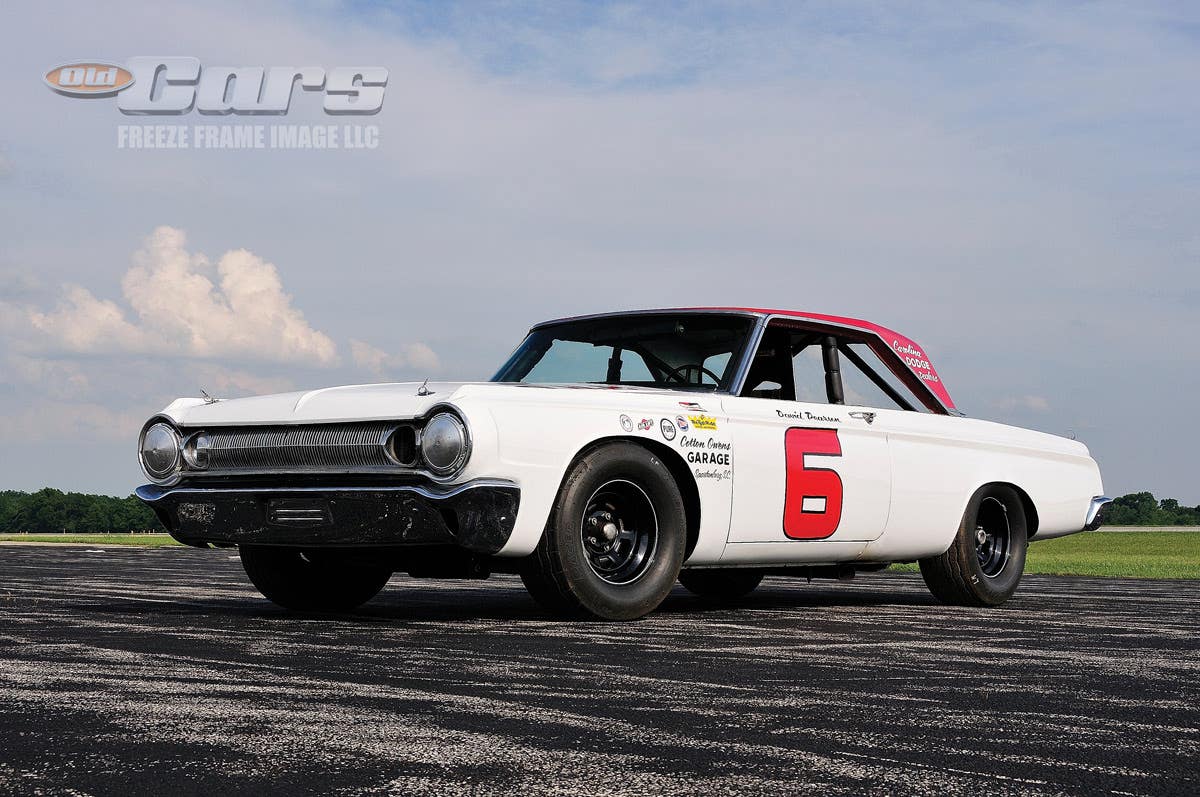
Under Owens’ guidance, Pearson spent countless hours at the Cotton Owens Garage. Their friendship led to Pearson joining the Cotton Owens Garage Racing team in 1964, driving a specially prepared Dodge Polara. Two years later, Pearson won the NASCAR Cup Series title in a white 1966 Dodge Charger with the red number 6 for Cotton Owens Racing.
The original 1966 Dodge Charger crafted by Cotton Owens Garage was retired after its championship season with Pearson behind the wheel. Yet its legacy lived on with those who contributed to its success.
In 2012, Boris Bonutti, while building a replica of Richard Petty’s 1964 championship-winning Belvedere Race Car, contacted Cotton Owens for rare parts. Owens agreed to help, provided Bonutti also replicated a 1966 Dodge Charger from his winning season with Pearson behind the wheel. Owens offered authentic parts for an accurate recreation of Pearson’s NASCAR-winning Charger, and an inspired Bonutti accepted.
The restoration of the 1966 Dodge Charger concluded in 2014, after Cotton Owens passed away. The Charger has been displayed at the NASCAR Hall of Fame and Darlington Raceway Stock Car Museum. Persistent suspension issues were eventually resolved when Bonutti entrusted David Pearson’s sons, Eddie and Ricky Pearson of the Pearson Racing Garage, to prepare the Charger for the track. By last fall, the Charger was track-ready, thanks to the Pearson family’s expertise.
“It means the world to me, and it’s an absolute honor to bring and keep the history of David Pearson, Cotton Owens and the 1966 Charger alive,” Bonutti said. “It’s bigger than life.”
The revitalization of the Charger restored a piece of racing history and symbolized the enduring bond between generations of NASCAR families. The project united original contributors and new caretakers, showcasing how racing heritage is celebrated and preserved through shared commitment and passion.
The Pearson family continues to uphold the legacy of the 1966 Dodge Charger that was recreated by Bonutti’s team using original parts from Cotton Owens. The project’s focus on authenticity and community, along with the Pearson Racing Garage’s role, demonstrates how tradition and skill keep iconic cars alive today.
The Dodge Charger Debuts
Dodge’s Coronet-based fastback Charger debuted in mid 1966, competing with the likewise midsize AMC Rambler Marlin and smaller Mustang 2+2. Compared to the Marlin, the Charger was considered more attractive, but carried a higher price.
The Charger’s interior set it apart, featuring a full-length center console and bucket seats both front and rear — a design inspired by the 1960-’62 Chrysler 300 and other personal luxury coupes of the period. The rear pseudo-bucket seats could be folded down for additional space accessible from the deck lid, enhancing versatility.
Positioned more as an upscale model, the Charger was not originally intended to directly compete with the performance-focused pony cars of its era. The base engine was a 230-hp 318-cid V-8 with a two-barrel carburetor and single exhaust. Optional was a two-barrel 361-cid V-8 of 265 hp with single exhaust and a four-barrel 383-cid V-8 with 325 hp and dual exhaust. Despite being something of a luxury car, the Charger could be optioned as a brawler with Chrysler’s famed 426 Hemi V-8, appealing to those seeking both performance and luxury. Just 468 Hemi Chargers were built that first year.
The public first saw the 1966 Charger on Jan. 1, 1966, during the Rose Bowl broadcast. Marketed as the “Leader of the Dodge Rebellion,” the Charger was designed by Carl “CAM” Cameron. Notable design features included its unique fastback roofline and a pot-metal “electric shaver” grille shared with the Coronet that had fully integrated and rotating headlamps, a design last seen on a Chrysler vehicle with the 1942 De Soto. The rear of the car featured a full-width taillight assembly with six lamps and chrome “CHARGER” lettering for a dramatic effect.
Standard Charger features included a simulated wood-grain steering wheel, four bucket seats, a full-length console and foldable rear seats for expanded cargo space. Unique interior elements included special door panels, courtesy lights, premium trim and vinyl upholstery. Dashboard gauges and controls were illuminated by electroluminescence instead of regular bulbs. Standard instruments included a 6,000-rpm tachometer, 150-mph speedometer and gauges for the alternator, fuel and temperature.
Following its mid-model-year debut, Dodge produced 37,344 Chargers in 1966, marking the beginning of an enduring legacy.
Innovation and Impact in NASCAR
Dodge immediately introduced the new Charger to NASCAR in 1966, hoping its slick fastback design would offer a competitive edge on high-speed tracks. The sleek body style caused aerodynamic lift at the rear, making handling difficult and leading drivers to liken the car to “driving on ice.” To solve this, Dodge added a small lip spoiler to the trunk lid, greatly improving traction above 150 mph. This feature was first available as a dealer-installed option in 1966 and became a production offering in 1967 to meet NASCAR homologation requirements, making the Charger the first U.S. production vehicle with a spoiler. Small quarter panel extensions were also added the following year.
This aerodynamic innovation was crucial to racing performance. David Pearson, driving the #6 Dodge prepared by Cotton Owens, leveraged these improvements to win the 1966 NASCAR Grand National championship, securing 15 first-place finishes that season.
Nuts and bolts in Charger Replica
The 1966 Charger built by Borris Bonutti for Cotton Owens is fitted with an authentic NASCAR 426 Hemi engine built by Petty’s Garage in Randleman, N.C., featuring period-correct NASCAR components: a magnesium oil pan with internal chain-drive dry sump pickup pump; large NASCAR oil pump for dry sump lines; “bathtub” intake with Holley LeMans carburetor; “Elephant Ears” front mounting bracket; Motorola double-pulley alternator with matching water pump and crank pulleys; and stainless-steel NASCAR headers with slip joint connectors that have been Jet Hot-coated for durability.
The Charger’s transmission is a Chrysler A-833 four-speed transmission. The unit was professionally rebuilt with new bearings and synchronizers. It is equipped with steel shift forks for enhanced durability and features a Hurst Competition Plus shifter.
The chassis is based upon a rust-free, all-original 1966 Dodge Charger body. The roll cage — made by Billy Biscoe of Denton, N.C. (formerly with Richard Petty and Cale Yarborough) — matches 1966 NASCAR Grand National Racing specs and uses .095 wall, 1.25-in.-diameter DOM steel tubing.
For braking, period-correct Wilwood four-piston aluminum calipers with NASCAR rotors are used at front, and the rears are current versions with cast rotors and aluminum hats. The master cylinder is a Chrysler single-reservoir unit. All lines are flared steel with AN fittings, and flexible caliper lines are Aeroquip braided stainless over nylon, with Aeroquip fittings.
The Charger features an ATL 22-gallon fuel cell secured within a steel enclosure. It is equipped with an Airtex NASCAR engine-mounted mechanical fuel pump and a 5/16-in. steel fuel line. The NASCAR-style fuel filler cap is positioned on the driver’s side. Fuel level monitoring is provided by an electronic Stewart-Warner gauge integrated into the dashboard, as well as a mechanical gauge mounted atop the fuel cell.
The rear axle is Chrysler 8-3/4 positive-traction unit with 3.23 gears, The rear axle houses Moser alloy axles with extended 5/8-in. wheel studs on a 5-in. bolt circle.
The front suspension is comprised of period-correct upper and lower control arms that were fabricated NASCAR parts. The uppers are adjustable tubes, while the lowers are reinforced C-Body arms for NASCAR use. Heavy-duty NASCAR spindles and hubs feature extra-long 5/8-in. studs on a 5-in. bolt circle. The wheels are Clement Industries original NASCAR wheels with reinforced centers.
The gauges are all Stewart-Warner Competition Series units. The tachometer and speedometer, and the ammeter, oil and water temperature and fuel gauges, are mounted in a period-correct aluminum panel. The battery is in the passenger-side trunk.
The project’s rust-free 1966 Dodge Charger body was fully disassembled, cleaned and refinished beneath in low-gloss black enamel. The fuel filler door and trunk emblem were removed for a flush, as-raced look, and the entire body was painted white with acrylic enamel. Aluminum panels detail the interior doors and rear, including a removable panel for the fuel cell area. A period-correct NASCAR spoiler is mounted at the back, and all car lettering was hand-painted to match the original Pearson NASCAR Charger.
Behind the authentic NASCAR 426 Race Hemi headers crafted from stainless steel. Tension springs connect the system to the headers, allowing for easy removal. Oval-shaped exhaust tips are positioned just behind the doors in their correct location.
Back to the Track
The 2026 NASCAR Cup Series Goodyear 400 spring weekend is scheduled to take place from Friday, March 20, through Sunday, March 22 at Darlington Raceway. The weekend will include a special exhibit featuring the 1966 Dodge Charger race car presented by the Bonutti team, in conjunction with Eddie and Ricky Pearson, to commemorate the 60th anniversary of the Owens Garage NASCAR Championship. The event will showcase the debut and historical significance of the Dodge Charger in NASCAR, with David Pearson and Cotton Owens being honored for their championship victory in 1966.
Following its presentation at Darlington Raceway, the 1966 Dodge Charger will proceed to Auburn, Ind., where it will be exhibited at the National Auto and Truck Museum (NATMUS). There, the Charger will join a prestigious display honoring David Pearson’s and Cotton Owens’ contributions to American motorsport history.
The exhibition, titled “Built to Win: Pearson & Owens Racing Heritage,” will comprise three significant vehicles. Alongside the 1966 Dodge Charger, visitors will have the opportunity to view David Pearson’s undefeated 1937 Ford race car, notable for both its unbroken record from 2003 to 2008, and its status as the final vehicle constructed and raced by Pearson himself. The collection also includes the last race car built by distinguished motorsports figure Cotton Owens: a 1964 Dodge Polara representative of the model campaigned by Pearson for Cotton Owens Garage. Together, these automobiles illustrate the enduring partnership and achievements of Pearson and Owens in motorsports, offering museum guests an insightful perspective on the era’s technological progress and competitive spirit.
The 1964 Dodge Polara represents the last race car project completed by Cotton Owens. Finished in 2004, the Polara was meticulously constructed to meet authentic NASCAR racing specifications. This vehicle features an original 1964 Hemi race engine, which Owens preserved in his specialized inventory at his Spartanburg, S.C., racing facility. Manufactured in compliance with NASCAR standards and prepared by Owens himself back in 1964, this engine played a significant role in helping Owens and David Pearson secure the 1966 NASCAR Championship.
“I take pride in knowing that I contributed to establishing the legacy of the Hemi engine,” said Owens back in 2005 after wrapping up the 1964 Polara project. “Currently, I am not affiliated with the Dodge NASCAR program and operate a Chrysler salvage yard. Recently, I completed building a 1964 Dodge model similar to those raced in 1964, equipped with... the second Hemi engine I received from Chrysler in 1964. To this day, I retain several of these engines.”
The 1964 Dodge Polara represents the final race car of Cotton Owens and was presented during his induction into the NASCAR Hall of Fame. It is scheduled for exhibition at NATMUS alongside the Pearson 1937 Ford and the featured 1966 Dodge Charger, in recognition of the 60th anniversary of the NASCAR championship achieved by Pearson and Owens in 1966.
Inside a Charger just like Dad’s
Back in November, we had an opportunity to witness a Pearson driving the 1966 Dodge Charger on the private road adjacent to the Pearson Racing Garage when Eddie got behind the wheel of the MoPar just like his father’s car. It was only fitting that the son of David Pearson was the first one to drive the track-ready Charger for the first time.
The Charger’s Hemi roared to life with a quick start. The raw power beneath the hood pulsed, and the unmistakable sound of the Hemi was pure music to the ears. As Eddie took the wheel, his drive became a celebration marking a proud family milestone underscoring the Charger’s legendary place in NASCAR history. The improved handling and racing spirit were on full display, honoring the car’s heritage with every rev. Soon, the Charger will take center stage at Darlington Raceway and NATMUS, where eager fans will gather to witness this icon and pay tribute to the lasting legacy of NASCAR Hall of Fame Legends David Pearson and Cotton Owens.
As excitement grows for the events ahead, the Charger highlights decades of motorsport innovation and competition. From its impactful NASCAR debut to its ongoing influence, this car continues to inspire fans old and new. Its presence at these exhibitions honors the legacies of Pearson and Owens and underscores American racing’s commitment to excellence. There’s growing anticipation for the long-awaited return of a Hemi-powered Charger to the NASCAR circuit, but this car is where it all started.
Bonus NATMUS race car display
The last Cotton built race car! The 1964 Dodge Polara powered by the X2 Prototype 426 Hemi Engine will also be on display at NATMUS.
SHOW US YOUR WHEELS!
If you’ve got an old car you love, we want to hear about it. Email us at oldcars@aimmedia.com
We know you love old cars, but do you collect anything else? Ever wonder about the baseball cards in a box in the basement or Grandma’s old coins in a jar? Do you love history or spin vinyl? Head on over to Collect.com and see what you are missing. Collect.com is the who, what, when and where of the collecting world! https://www.collect.com/