
When was ‘Before the War?’
Exploring the complex definition of “prewar” cars and how WWII’s staggered start dates affect automotive classification from 1939-1942.
Years ago, it was simple to understand the term “before the war.” When the car hobby was maturing in the 1960s and 1970s, everyone understood that the reference “prewar car” was the designation for an auto made in any country prior to the Second World War. But even this was an unclear designation. Technically, that war began for some countries in late 1939 with Germany’s invasion of Poland. But for the United States, the war began in December 1941 with the bombing of Pearl Harbor by the Japanese. As the act against the United States was being officiated in the national administration, Germany and its allies were quickly included in the paperwork as enemies.
So, are American-made cars produced in late 1939 through early 1941 really “prewar?” It is difficult to assess when the actual production numbers of given makes match to the true period of wartime declaration, but it would be interesting if someone took hold of that task, just to clarify the term. In truth, it may prove very little. Then again, there may be some very interesting factors in production that rise to the surface. For the sake of clarity, this writer would hope that the task is done while production numbers-per-date may still be in some special files accessible to “old car number crunchers” who like to bring to light some forgotten elements of car making.
What could result? Vintage car shows wherein cars from 1939 through 1942 are lined up for comparison, showing common traits and subtle differences in parts and features (possibly seemingly small differences, but who could know unless such a study and show are held?).
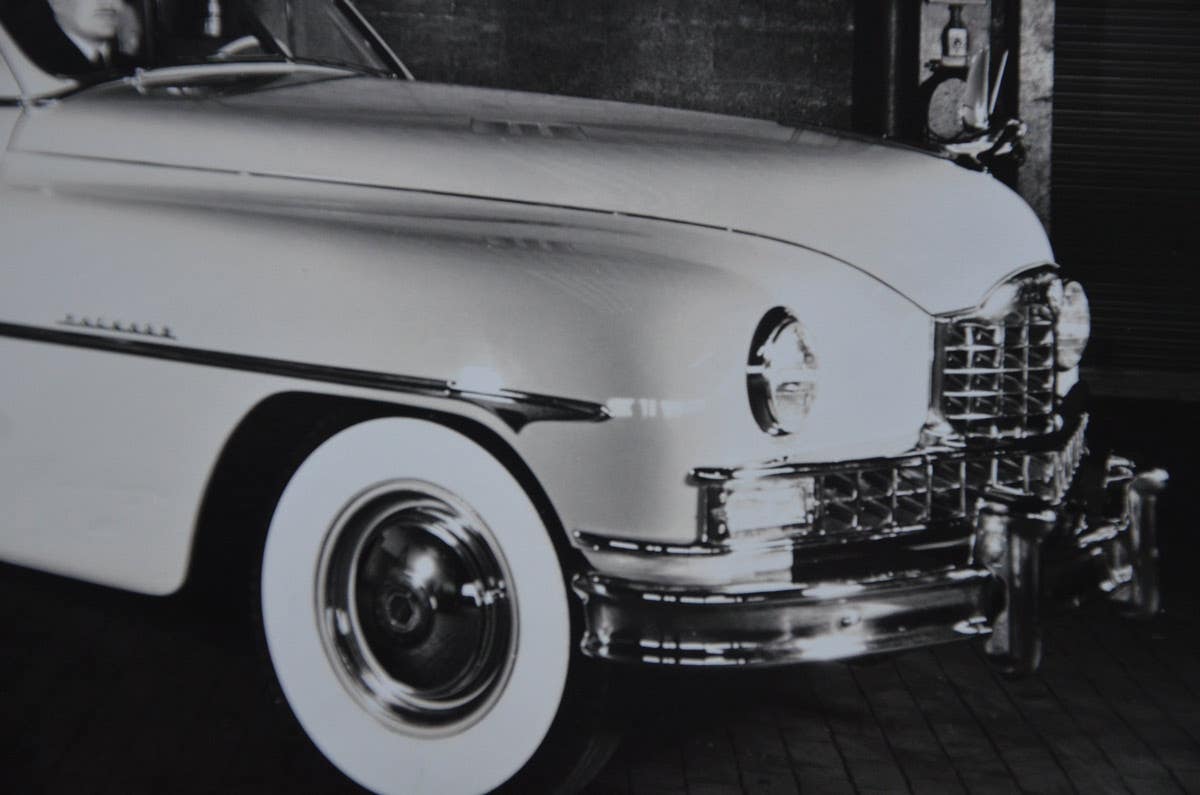
The matter could mature into special categories: If the European start of the war is the gauge, then two special categories surface: Early 1939 prewar vs. Late 1939 wartime. And what about the prewar production that was stockpiled by auto agencies and distributors for later sale? This writer knows for a fact (and verified by several administrative and eyewitness accounts) that one St. Louis Packard distributor stockpiled as many as 300 new cars in a deep cave not far away in Illinois to be sold per Federal approval on priority basis during the war. Makes a person wonder how many of those “prewar” 1939s and early 1940s versions may still exist with no credit for that special dispensation?
And what about paint? Some cars during the war were painted olive drab (so to speak) for use in or near battle areas or potential bombing districts. The drab paint kept reflection by sun or artificial light from giving gunners or bombers exact targets. Yet, in areas free from the chance of bombing, shiny paint seemed to be little (if any) problem.
As we can understand, the differences between prewar and wartime models may be slight but truly historic. What colors were dropped and which others became prominent? Did black give way to lighter colors? What of natural coloration, such as greens and grays? Perhaps someone did (or can) do such a study on factory-paint car colors as the war neared and then came to the life of car-buying Americans.
To some readers, these notions may be arbitrary. To others, their minds may hasten to begin a search. Who really knows or could project the results? This would take digging into files, and whether results and calculations plus production techniques surface as very interesting variables is purely a guess for now. Still, the minds of mankind can swirl and swing widely in the hunt. And, just perhaps, our old car hobby may gain new vistas never found before.
Much could be said for the next war fought by America — the Korean War of the early 1950s. It may be historically satisfying to know how many people during that era were driving “prewar cars” made before the Second World War. How many wartime cars survived well into the 1950s as daily drivers?
What I have stated in this column is not meant for fun or folly as much as discovery. Call it a “tune-up” on our enjoyment of the hobby plus an investigation into obscure factors of car making that may have been missed by some of our best historians.
Case in point: This writer owns a 1941 Packard Clipper, verified as a normal production model-turned-military vehicle for higher-echelon officers and sold as wartime surplus after being stored in a military “dumping ground.” Turned out that the metallurgy used in engine parts was better than succeeding parts in the immediate postwar era (1946-’47). Will wonders never cease?
Seek, and ye may find.
If you like stories like these and other classic car features, check out Old Cars magazine. CLICK HERE to subscribe.
Want a taste of Old Cars magazine first? Sign up for our weekly e-newsletter and get a FREE complimentary digital issue download of our print magazine.
We know you love old cars, but do you collect anything else? Ever wonder about the baseball cards in a box in the basement or Grandma’s old coins in a jar? Do you love history or spin vinyl? Head on over to Collect.com and see what you are missing. Collect.com is the who, what, when and where of the collecting world! https://www.collect.com/