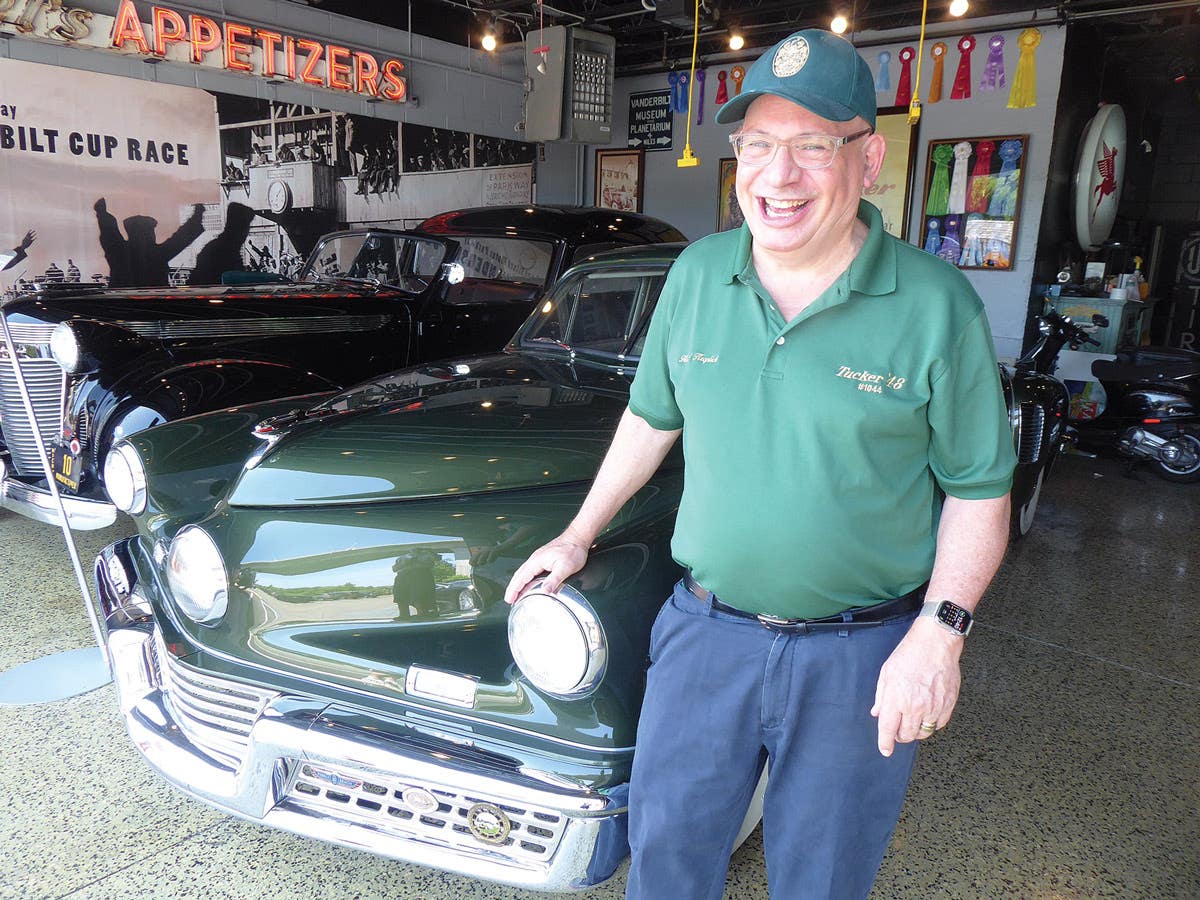


We visited Jeff Stumb, executive director of the Stahls Motors & Music Experience in Chesterfield, Mich., as he prepared its 1963 Chrysler Turbine Car for the Hilton Head Concours d’Elegance. During his initial drive, he observed the vehicle’s advanced design, smooth handling, modern features, innovative instrumentation and even the concealed ashtray intended for rear passengers. Following the test drive, Jeff commented that the vehicle exhibited outstanding performance and evoked comparisons to the jet-powered cars depicted in the “Jetsons” television program from his youth. His experience made him one of only a few hundred civilians to have ever experienced driving a 1963 Chrysler Turbine Car.
With its striking design and innovative engineering, the Chrysler Turbine Car captivated automotive enthusiasts and the general public alike. Its unique engine sound and futuristic appearance made it a memorable icon of 1960s automotive experimentation, symbolizing both technological optimism and the challenges of bringing radical new concepts to market.
A turbine car for the masses
Chrysler Corp. produced its most famous turbine car from late 1962 to October 1964 as 1963 models. Bodied by Carrozzeria Ghia of Italy and final-assembled in Detroit, only 55 cars were built. Of those 55 Turbine cars, 5 were prototypes and 50 were built for public testing. Nearly all of them were finished in a paint color that Chrysler called Turbine Bronze that was complemented by a black vinyl top. At least one white example is known to have been produced and was one of two Turbine Cars to appear at the New York World’s Fair, where Chrysler gave rides to visitors. This white Turbine Car (or a different white Turbine Car altogether) also publicly appeared in the 1964 film “The Lively Set.” Otherwise, the cars were indistinguishable from one another and even used the same ignition key.
Elwood Engel, who is also credited with designing the 1961 Lincoln Continental and Ford Thunderbird while at Ford Motor Co., led the Turbine Car design process, with former Ford Motor Co. designer Charles Mashigan also receiving credit for his part designing the 1963 Chrysler Turbine Car. These men’s earlier work designing the 1961 Thunderbird is why the cars cut a similar profile and also share jet-inspired design influences. But whereas the Thunderbird relied on a missile shape, the Turbine Car used a turbine theme throughout.
The Turbine Car’s turbine theme was apparent throughout the exterior of the car, from the round, vaned headlamp bezels to the similarly vaned wheel cover centers and preposterously oversized, vaned housings for the small rear reflectors. Even inside, the full-length floor console that divided the individual front and rear leather-trimmed bucket seats was a giant silver shaft with vanes at the front and rear. The steering wheel hub design matched that of the headlamp bezels, and behind it was an instrument panel housing three large, round pods. It was nothing like anything else in a Chrysler product of the period.
As a top-line Chrysler product, each Chrysler Turbine Car touted such amenities as air-over-oil power drum brakes, power steering, TorqueFlite automatic transmission, radio and heater. The chassis was fitted with a conventional independent front suspension with coil springs and rear leaf springs. It is believed that it cost Chrysler Corp. as much as $55,000 (about $558,000 in 2025) to build each car, about $20,000 of which was just in the hand-built Ghia body.
A turbine future?
When Chrysler began researching turbine engines for aviation in the late 1930s, the program was led by executive engineer George Huebner. After World War II, Huebner and fellow engineers Bud Mann and Sam B. Williams started exploring turbine-powered cars. Turbine engines attracted interest due to their simpler design and fuel flexibility compared to piston-powered counterparts that ran only on gasoline or diesel fuel. By the mid 1950s, Chrysler was a leader in gas turbine car research, although General Motors and Rover also experimented with turbine cars.
After refining its turbine design with a regenerator to improve heat exchange, Chrysler installed a turbine engine in a mostly stock 1954 Plymouth Belvedere. On June 16, 1954, it unveiled the turbine-powered Belvedere at Chelsea Proving Grounds in Michigan before more than 500 reporters. However, engineers found that heating, cooling and emissions posed major engineering challenges for integrating a turbine engine into a car. The engines were also expensive to build and operate, so they weren’t feasible for everyday use by the masses. There was good news, though: Chrysler claimed this turbine had 20 percent fewer parts and weighed 200 pounds less than similar piston engines.
Chrysler continued its turbine research and introduced its next turbine car, this time a mostly stock 1956 Plymouth, on March 23, 1956. Huebner drove it 3,020 miles from New York City to Los Angeles, followed by a support team, with only two minor (non-engine) repairs needed. The successful trip prompted Chrysler to expand its turbine program and relocate operations to a bigger Detroit facility.
A subsequent version of the Chrysler turbine engine (the second-generation model) was installed in a 1959 Plymouth and achieved an average fuel efficiency of 19.4 miles per gallon during a journey from Detroit to Woodbridge, N.J. This performance represented a notable improvement over the 13 mpg recorded by the first-generation turbine during the 1956 New York-to-Los Angeles trip.
When Chrysler Corp. introduced its third-generation turbine engine, the CR2A, it became the company’s first officially named turbine engine. This engine worked to reduce the high cost of turbine engine production. During development in May 1960, Huebner noted that the turbine functioned as its own torque converter, produced 140 hp, had a 1.5-second acceleration lag (improved from 9 seconds previously) and weighed 150–450 lb less than similar piston engines.
Photo by Keystone-France/Gamma-Rapho via Getty Images)
Third-generation CR2A turbines were integrated into various vehicles, such as a 2-1/2-ton 1960 Dodge truck and the Chrysler Turboflite concept car. Refined CR2A turbines were also installed in a 1962 Dodge Dart and Plymouth Fury, and again Chrysler took its turbine cars to the road, driving the Dart from New York City to Los Angeles in December 1961. The Fury completed a much shorter journey from Los Angeles to San Francisco in January 1962. Upon arriving at Los Angeles with the Dart, Huebner dedicated two hours to providing journalists with test rides in the turbine-powered vehicle.
Chrysler showcased its fleet of turbine cars across North America, Europe and Mexico in February 1962, visiting 90 cities and giving rides to nearly 14,000 people, thus reaching millions more observers. The third-generation turbine program concluded at the Chicago Auto Show that same month, where Chrysler displayed its turbine-powered vehicles, including the turbine-powered Typhoon concept car, which loaned its front and rear styling to the 1963 Turbine Car (and nearly loaned its name). Just before the event, the company announced plans for a fourth-generation turbine engine to be installed in a limited run of 50-75 cars (the final total was 55), which would be loaned to the public free of charge starting in 1963. The company said the decision was driven largely by the enthusiastic response to the touring demonstrations.
Chrysler’s most famous turbine car
The 1963 Chrysler Turbine Cars were powered by the A-831, the name of Chrysler’s fourth-generation turbine engine. Unlike its predecessor, the CR2A, the A-831 featured twin regenerators, one on each side of the gasifier, instead of a single heat exchanger mounted on top. This reduced the engine’s weight by 40 lbs., bringing it down to just 410 lbs. Due to their design, these engines did not need antifreeze, a cooling system, radiator, connecting rods or crankshafts.
The A-831 could run on diesel fuel, unleaded gasoline, kerosene, JP-4 jet fuel and various unconventional fuels including furnace oil, perfume, peanut oil and soybean oil. However, leaded gasoline would damage it. Chrysler engineers even confirmed that Mexican President Adolfo López Mateos successfully operated one of these cars using tequila as fuel. A few Americans were also said to have poured their favorite alcohol — including Jack Daniels — in Turbine Cars’ fuel tanks to power them.
The engine generated 130 hp at 36,000 rpm and idled between 18,000 and 22,000 rpm. Many bystanders compared its sound to the whoosh of a vacuum cleaner. At stall, it was capable of producing 425 lb.-ft. of torque. While idling, its exhaust temperature did not exceed 180 degrees Fehrenheit. When operating at 120 mph, the turbine reached its maximum speed of 60,000 rpm. Accelerating from 0-60 mph took about 12 seconds.
Turbine Cars hit driveways
From October 1963 to January 1966, a total of 203 people —180 men and 23 women, aged 21 to 70 — participated in Chrysler’s Turbine Car test program. They lived in 133 cities across the 48 contiguous states and Washington, D.C., and 60 percent were already Chrysler owners. At least one Turbine Car also made an appearance in Europe. British journalist Robert Walling of the Evening Standard posed with a Turbine Car in the United Kingdom during October 1963 after that car appeared at the Salon de l’Automobile in Paris. Lucky members of the U.S. test group each had use of their Turbine Car for three months at no cost, but they were responsible for the cost of fuel. In the agreement with Chrysler Corp. to use the cars at no cost, testers would provide Chrysler with detailed feedback from their experience driving them. In total, the testers racked up more than 1 million miles of driving.
Initial issues included sluggish acceleration due partly to their heavy body construction and vibration from tire treads, noticeable due to the smooth turbine engine. Benefits were the smooth engine, the turbine’s reduced need for maintenance and generally easy starts in a variety of conditions. However, some people in higher altitudes experienced starting trouble. Other common complaints were poor fuel economy and a relatively loud noise level. When Chrysler investigated the noise complaint, however, it discovered about 60 percent of users liked the car’s jet-like turbine sound, while around 20 percent disliked it (the remaining 20 percent were indifferent).
Regardless of whether or not testers found they would buy a turbine-powered car if and when they became available, all found the experience memorable. Crowds would gather whenever one of the futuristic Turbine Bronze cars stopped — even when the cars were parked in the testers’ driveways! Although the testers didn’t get to keep the cars, many had one of the popular Turbine Bronze plastic scale promotional models as a keepsake.
The fate of Chrysler’s experiment
In April 1966, Harry E. Chesebrough, Vice President of Product Planning and Development, stated that the test cars would be retired regardless of whether the Chrysler Turbine Car entered production. Chrysler ended up destroying 46 cars after completing user testing and public displays; 45 were obliterated at a scrapyard south of Detroit, while another was demolished at its Chelsea Proving Grounds. Essentially, these test cars were concepts, and Chrysler likely destroyed most of them to eliminate the possibility of liability issues, as is the practice for experimental cars. As one Chrysler executive explained in Look magazine, “Our main objective is research, and we did not want turbines turning up on used-car lots.” Destroying the cars also helped protect Chrysler’s proprietary secrets.
Nine 1963 Chrysler Turbine Cars still exist, all of which are painted Turbine Bronze. Chrysler retained three cars (two of which it still owns), while the other six were sent to museums. Today, at least three of the Turbine Cars are known to be operational: the Turbine Car owned by Jay Leno; the restored example owned by the National Museum of Transportation; and the featured Turbine Car owned by the Stahls Motors & Music Experience.
Ted and Mary Stahl, founders of the Stahls Motors & Music Experience, acquired their Turbine Car in 2021. It previously belonged to the Harrah Collection, from which renowned collector Tom Monaghan purchased it. Equally distinguished collector Frank Kleptz owned the car after Monaghan sold it and kept it in his collection through his passing.
Today, the Stahls Motors & Music Experience regularly displays its Turbine Car at events and among its collection.
The Stahls Motors & Music Experience is a 501(c)(3) non-profit organization that exists to preserve, restore and exhibit classic automobiles of the 20th Century for educational purposes. The Experience, based in Chesterfield, Mich., features continually changing exhibits of historically significant vehicles from the Depression and Art Deco eras, along with mechanical music machines and automobile memorabilia. It also hosts many community events throughout the year while being open to the public, including an annual fundraising event honoring and benefiting U.S. military veterans.
Stahls Motors & Music Experience
Chesterfield, MI
www.stahlsauto.com
586-749-1078
SHOW US YOUR WHEELS!
If you’ve got an old car you love, we want to hear about it. Email us at oldcars@aimmedia.com
If you like stories like these and other classic car features, check out Old Cars magazine. CLICK HERE to subscribe.
Want a taste of Old Cars magazine first? Sign up for our weekly e-newsletter and get a FREE complimentary digital issue download of our print magazine.